Five for Friday – May 22, 2026
Momentum, Parabolic, Selloffs, Profits, and On This Day
1. Momentum
Last week marked 30 trading days off March’s stock market low. Over that time, the S&P 500 rose 17%. Going back 75 years, there have only been a handful of 30-day rallies so intense (roughly one quarter of one percent of the time). The power of this observation, however, is in what has historically come next. Of the nearly 100 times the S&P 500 rose 15%+ over a 30-day stretch, the average return over the next year was 25% – with just four negative readings total (all May 2001). The market might need a breather, but momentum like this is typically bullish longer-term.
2. Parabolic
Longer-term optimism aside, some recent market activity does merit a more critical eye. Since 1972, the S&P 500 Momentum Index – which gives bigger weights to recent winners – has never seen a six-week return as large as the one we just saw, and certain corners of the stock market (e.g., semiconductors) have gone vertical. Parabolic price moves are almost by definition driven by momentum, sentiment, and the fear of missing out (FOMO), and can reverse quickly and violently given their “shakier” foundation. Two things can be true: one of the most common investor mistakes is selling too early AND risk management is paramount to both building and maintaining wealth. In a market like this, it is important to focus on position management. The goal is never to perfectly time the top in a position that goes parabolic, but to ensure that no single holding, industry, or theme ends up dominating your portfolio. Diversification, rebalancing, and risk miniminization – these are key tenets of investing, whether in a boom time or downturn.
3. Selloffs
Because of widespread stock market “bubble” discourse, market hiccups spark louder-than-usual calls that the sky is falling and the bubble is popping. But the stock market can also go down without signaling the end of a broader bull market. Even in the late 1990s, a stretch defined by internet optimism and outsized stock market gains, Tech stocks – and the broader market – were not insulated from weakness. In 1997, 1998, and 1999, the S&P 500 returned 33%, 29%, and 21%, respectively. And yet each year also featured a double-digit intrayear drawdown. Across all years, the average selloff was about 14%. That’s table stakes. Protecting positions and managing risk are prudent, but getting spooked out of a bull run entirely is a bad way to create wealth.
4. Profits
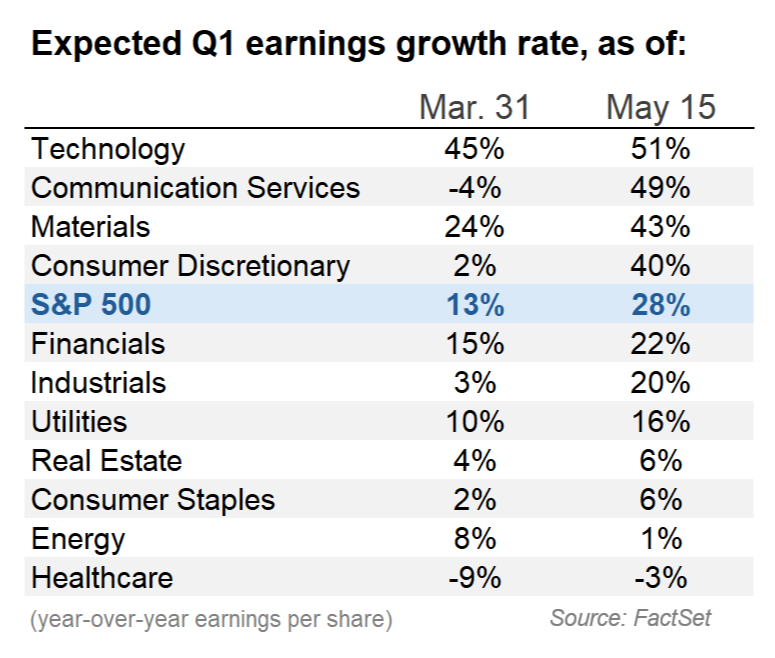
The admittedly tricky thing to suss out in this market is whether the upward price action is bubbly or just reflecting strong corporate profits. We’ve covered the outsized sales and earnings growth seen in the first quarter of 2026 (especially striking when compared to estimates from just six weeks earlier, as shown in the table), and the AI space is no exception. JPMorgan’s Michael Cembalest notes that since Nov. 2022, a basket of just 42 AI-centric stocks is responsible for over three-fourths of the S&P 500’s price gain, but that the same group is also responsible for nearly 90% of the S&P 500’s earnings growth. AI is generating a lot of hype but, for now, it’s generating real profits too.
5. On This Day
in history, a litany of transportation milestones: the first steamship to cross the Atlantic leaves port (1819), the Wright Brothers are granted a patent for their “flying machine” (1906), and SpaceX’s Falcon 9 becomes the first commercial flight to dock at the international space station (2012). Where to from here for transportation? Autonomous vehicles? Electric vertical take-off and landing (eVTOL)? Maglev trains? The return of the Segway? I’m excited to find out.
Disclosures
This is not a complete analysis of every material fact regarding any company, industry or security. The opinions expressed here reflect our judgment at this date and are subject to change. The information has been obtained from sources we consider to be reliable, but we cannot guarantee the accuracy. Market and economic statistics, unless otherwise cited, are from data provider FactSet.
This report does not provide recipients with information or advice that is sufficient on which to base an investment decision. This report does not take into account the specific investment objectives, financial situation, or need of any particular client and may not be suitable for all types of investors. Recipients should not consider the contents of this report as a single factor in making an investment decision. Additional fundamental and other analyses would be required to make an investment decision about any individual security identified in this report.
For investment advice specific to your situation, or for additional information, please contact your Baird Financial Advisor and/or your tax or legal advisor.
Past performance is not indicative of future results and diversification does not ensure a profit or protect against loss. All investments carry some level of risk, including loss of principal. An investment cannot be made directly in an index.
Copyright 2026 Robert W. Baird & Co. Incorporated.
Other Disclosures
UK disclosure requirements for the purpose of distributing this research into the UK and other countries for which Robert W. Baird Limited holds an ISD passport.
This report is for distribution into the United Kingdom only to persons who fall within Article 19 or Article 49(2) of the Financial Services and Markets Act 2000 (financial promotion) order 2001 being persons who are investment professionals and may not be distributed to private clients. Issued in the United Kingdom by Robert W. Baird Limited, which has an office at Finsbury Circus House, 15 Finsbury Circus, London EC2M 7EB, and is a company authorized and regulated by the Financial Conduct Authority. For the purposes of the Financial Conduct Authority requirements, this investment research report is classified as objective.
Robert W. Baird Limited ("RWBL") is exempt from the requirement to hold an Australian financial services license. RWBL is regulated by the Financial Conduct Authority ("FCA") under UK laws and those laws may differ from Australian laws. This document has been prepared in accordance with FCA requirements and not Australian laws.